
The Jobs Nobody Counts: The American Employment Story Data Center Critics Are Missing
The construction jobs are temporary. The permanent jobs are few. Both statements are true as far as they go, and that is precisely the problem: they do not go very far.
Walk up to the fence line of any hyperscale data center under development and you will hear the same two-sentence critique. The construction jobs are temporary. The permanent jobs are few.
Both statements are true as far as they go. And that is precisely the problem: they do not go very far. Measuring a data center's employment impact by counting badges inside the building is like measuring an airport's employment impact by counting air traffic controllers. The count is accurate. The conclusion drawn from it is not.
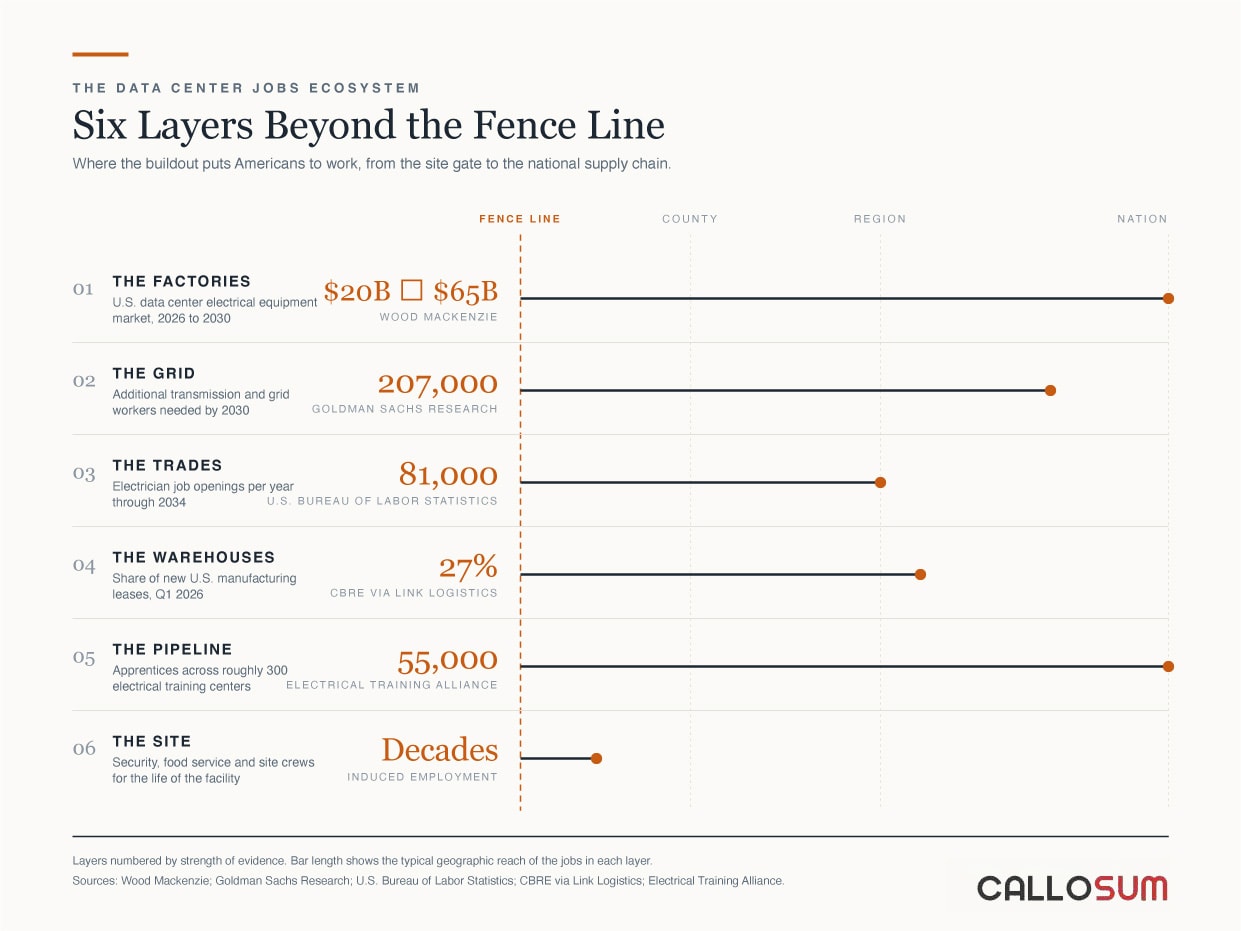
The real employment story of the American data center buildout is happening in places the fence line cannot contain: a transformer plant in Charlotte, a switchgear factory in Nebraska, a substation crew two counties over, a 740,000-square-foot warehouse in Columbus, an apprenticeship classroom in Tulsa. These are American jobs, held by American workers, paying American taxes. They exist because data centers are being built. And almost none of them appear in the jobs number stamped on a project's fact sheet.
This piece maps that ecosystem, layer by layer, from the hardest evidence to the most local. Every figure is sourced, and where a number comes from an industry-commissioned study, it is labeled as such. The argument does not need inflation. The documented record is strong enough on its own.
Start with the honest number, not the convenient one
In May 2026, economists Dany Bahar and Greg Wright published the most rigorous independent study of data center employment effects to date, summarized by the Brookings Institution. Analyzing roughly 770 U.S. facilities across 93 counties against thousands of control counties, they found that counties receiving their first large data center see total private employment rise 4 to 5 percent over five to six years, with construction employment up 11 percent. In a typical county, that translates to roughly 2,000 to 4,000 additional jobs. They also found that naive estimates overstate local effects by about a factor of three.
Critics of data center development treat this study as a ceiling. It is better understood as a floor, for one structural reason: Bahar and Wright measured employment in the county where the facility sits. But the data center supply chain does not respect county lines. The workers who build the transformer do not live where the transformer is installed. The lineworkers upgrading a 230-kilovolt corridor may work three counties away from the campus they are connecting. The factory hiring in South Carolina is responding to demand in Arizona, Oklahoma, and Wisconsin.
A county-level lens is the right tool for evaluating local incentive deals. It is the wrong tool for evaluating the national employment footprint, because the defining feature of that footprint is dispersion. The jobs land somewhere else. That is not a weakness of the story. For a national economy, it is the story.
A county-level lens is the right tool for evaluating local incentive deals. It is the wrong tool for evaluating the national employment footprint.
For scale, the industry's own commissioned research puts a number on the full footprint: a 2026 PwC study for the Data Center Coalition found the industry directly employed just over one million people in 2024, with each direct job supporting more than 4.5 additional jobs across the economy, for a total employment contribution of 5.5 million jobs, up 17 percent in a single year. That figure comes from an IMPLAN input-output model paid for by a trade association, and readers should weigh it accordingly. What follows is the evidence that does not depend on any multiplier at all.
Layer one: The factories
The most concrete rebuttal to the "few jobs" critique is not an economic model. It is a set of street addresses.
Every data center requires transformers to step power down from the grid, switchgear to distribute it safely, uninterruptible power systems to protect it, and cooling plants to remove the heat it becomes. For decades, much of that equipment came from overseas. The scale of the current buildout is pulling manufacturing back onshore, because lead times measured in years are intolerable when facilities are racing to energize.
Wood Mackenzie projects the U.S. data center electrical equipment market will grow from roughly $20 billion in 2026 to $65 billion by 2030, with data centers potentially accounting for as much as 40 percent of total U.S. electrical equipment demand by decade's end, up from a historically single-digit share. Transformer demand alone is projected to rise from about 1,500 units per year to more than 9,000.
A skeptic can argue with a multiplier. It is much harder to argue with a factory.
Siemens Energy has committed more than $1 billion to U.S. grid infrastructure, including a new large power transformer plant in Charlotte, North Carolina, targeting production in 2027. Hitachi Energy has committed a comparable sum to North America, including a Virginia transformer facility expected to be the largest in the country by 2028. Eaton announced $340 million to expand three-phase transformer production in Jonesville, South Carolina, a new medium-voltage switchgear facility in Bellevue, Nebraska, and continued transformer manufacturing at two Wisconsin plants, part of more than $1.5 billion in manufacturing investment since 2023. Schneider Electric has committed over $700 million through 2027 to scale U.S. power system production.
These are durable manufacturing jobs: machinists, welders, winders, assemblers, quality engineers, plant managers. They are located in communities that will never host a hyperscale campus. And they exist for one reason. A skeptic can argue with a multiplier. It is much harder to argue with a factory.
Layer two: The grid
Before a single server rack arrives, the electric grid around a data center has to grow: new substations, upgraded transmission corridors, reconductored distribution lines, protection and control systems. That work is performed by one of the most identifiable and undercounted workforces in the ecosystem.
Goldman Sachs Research estimated in 2025 that the U.S. power sector will need an additional 207,000 transmission and grid connection workers, plus another 300,000 across manufacturing, construction, and operations, to add 300 gigawatts of capacity by 2030. The Edison Electric Institute reports investor-owned utilities plan $1.1 trillion in grid upgrades and expansions between 2025 and 2029. Every dollar of that capital becomes wages before it becomes wires: lineworkers, substation electricians, relay technicians, civil crews, right-of-way surveyors, protection engineers.
207,000 — Additional transmission and grid connection workers needed by 2030 (Goldman Sachs Research)
$1.1 trillion — Planned grid investment by investor-owned utilities, 2025 to 2029 (Edison Electric Institute)
None of these workers appear on a data center's employment disclosure. All of them are employed, in meaningful part, because of data center load growth. When a community asks "where are the jobs," part of the honest answer is: on the transmission corridor, wearing a hard hat, two counties over.
Layer three: The trades, and the shortage that proves the point
The construction phase of a hyperscale campus can employ well over a thousand tradespeople for years, and the trades themselves are the clearest place where federal data confirms the demand.
The Bureau of Labor Statistics projects electrician employment will grow 9 percent from 2024 to 2034, much faster than the average for all occupations, with about 81,000 openings per year across a workforce of roughly 819,000. BLS names data centers, grid modernization, and electrification among the demand drivers. The U.S. Census Bureau documented that employment in the data center sector itself grew more than 60 percent between 2016 and 2023, from roughly 306,000 to 501,000 workers, before the AI acceleration fully arrived.
Here is the rhetorical pivot critics have not answered. The single most-cited constraint on data center construction today is not land, not capital, not chips. It is people. Microsoft president Brad Smith has publicly identified the electrician shortage as the biggest bottleneck slowing data center expansion. The National Center for Construction Education and Research projects roughly 41 percent of the current construction workforce will retire by 2031, and Deloitte's analysis of job postings found data center developers and power companies now compete for the same core workforce, with more than a third of new postings targeting the same occupations.
An industry cannot simultaneously cause a national skilled-labor shortage and create no jobs.
The shortage is the jobs story, told from the other direction.
Layer four: The warehouses
The least examined layer of the ecosystem may be the industrial real estate that forms around every major data center market, a trend the Wall Street Journal highlighted in July 2026 in its reporting on the rebound in U.S. warehouse development.
The underlying numbers are striking. According to CBRE data cited by Link Logistics, data center-related tenants accounted for 27 percent of all new manufacturing leases signed in the first quarter of 2026, the largest share of any tenant category. Link Logistics' own research estimates that every gigawatt of data center construction generates roughly 2 million square feet of spillover industrial demand.
27% — Share of all new U.S. manufacturing leases signed in Q1 2026 that came from data center-related tenants, the largest of any category (CBRE via Link Logistics)
The composition of that demand matters more than its size, because it answers the "temporary" critique directly. Link Logistics reports the majority of the spillover is operational rather than construction-driven: maintenance contractors, cooling and power infrastructure vendors, server testing and reverse logistics providers who sign leases that outlast the build. In Columbus, the firm leased a 740,000-square-foot building to a logistics provider whose end customer is Meta, storing components and equipment to support the company's data center campus. In Atlanta, electrical suppliers and maintenance companies are absorbing warehouse space as facilities come online.
Every one of those buildings employs forklift operators, inventory specialists, drivers, dispatchers, and facility technicians. They service data centers for a living. They have never been counted as data center jobs.
Layer five: The pipeline
A workforce this large does not train itself, and the training infrastructure is itself an employment category: instructors, program administrators, curriculum developers, community college faculty.
The Electrical Training Alliance, the joint apprenticeship body of the IBEW and the National Electrical Contractors Association, operates nearly 300 training centers with roughly 55,000 apprentices enrolled, and utilities and hyperscalers are funding new high school and community college programs in data center markets to build local pipelines. These apprenticeships are the classic American on-ramp to the middle class: paid from day one, no degree required, leading to a licensed trade with documented wage upside. The data center buildout is, among other things, the largest skilled-trades recruitment campaign in a generation.
Layer six: The everyday economy
Finally, there are the jobs closest to the site: security officers on 24/7 rotations, landscaping crews, janitorial and facilities staff, food service workers, local fuel and equipment suppliers. In economic terms these are induced jobs, the softest tier of the evidence, and honest advocacy should label them that way rather than lead with them. But they are real paychecks in real communities, and they persist for the life of the facility, which is measured in decades.
The part everyone forgets: these workers pay taxes
The public conversation about data centers and taxes focuses almost entirely on what facilities pay, or are exempted from paying. It rarely accounts for the payroll, income, and sales taxes generated by the workforce ecosystem itself. The PwC analysis, with the industry-commissioned caveat noted above, estimated the sector's total tax contribution at $204.4 billion across federal, state, and local governments in 2024. Even discounting the modeled portions heavily, the direction is unambiguous: a transformer plant worker in Charlotte, a lineworker in Oklahoma, and a warehouse technician in Columbus all fund schools, roads, and public safety in their own communities, as a direct consequence of facilities they may never see.
$204.4 billion — Estimated federal, state, and local tax contributions of the data center industry in 2024 (PwC, industry-commissioned analysis for the Data Center Coalition)
The right question
None of this argues that communities should stop scrutinizing data center proposals. Incentive deals deserve rigorous evaluation. Independent research like Bahar and Wright's deserves engagement, not dismissal. Claims discipline cuts both ways, and the industry has at times earned skepticism by overpromising local hiring.
But the prevailing critique rests on a measurement error. It counts the jobs inside the fence line and declares the ledger closed. The American data center buildout is employing electricians in Phoenix, lineworkers in Tulsa, factory workers in Charlotte and Jonesville and Bellevue, warehouse crews in Columbus and Atlanta, and apprenticeship instructors in nearly 300 training centers nationwide. Some of those jobs are local. More are regional. The largest share is national.
The right question was never "how many badges are inside the building." It is "how many paychecks exist across the economy because the building does."
On the evidence, the answer is: far more than anyone is counting.
Explore Topics
Written by
Callosum Consulting
Content creator and writer sharing insights and stories.